Quick Stats
Completed
0
Time Spent
0m
Streak
0

User
What is Machine Learning?
Understand what machine learning really means and how it differs from traditional programming.
Machine Learning (ML) is a way of teaching computers to learn from experience, rather than being explicitly programmed for every task.
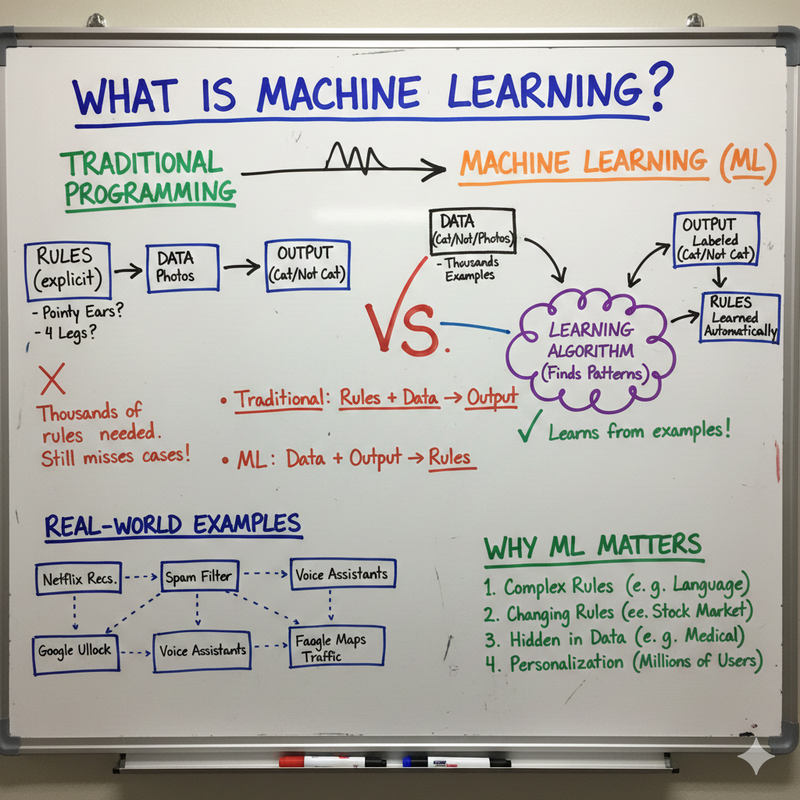
Think of it like this: Traditional programming is like giving someone a recipe. You tell them exactly what to do, step by step. Machine Learning is more like teaching someone to cook by showing them many examples of good dishes, and letting them figure out the patterns themselves.
The Traditional Programming Way
Imagine you want a computer to identify cats in photos. With traditional programming, you'd need to write explicit rules:
- If it has pointy ears → might be a cat
- If it has whiskers → might be a cat
- If it has four legs → might be a cat
- If it says "meow" → definitely a cat
But what about cats with folded ears? Or three-legged cats? Or silent cats? You'd need thousands of rules, and you'd still miss cases.
The Machine Learning Way
Instead of writing rules, you show the computer thousands of cat photos (labeled "cat") and thousands of non-cat photos (labeled "not cat"). The computer finds patterns in the data automatically.
The computer might discover patterns you never thought of:
- Certain textures in fur
- Specific eye shapes
- Proportions between facial features
- Color patterns
It learns these patterns from data, not from explicit rules you wrote.
Key Difference
Traditional Programming: Rules + Data → Output
Machine Learning: Data + Output → Rules (learned automatically)
In ML, we don't tell the computer HOW to solve a problem. We show it examples, and it figures out the HOW by itself.
Real-World Examples
Machine Learning is already everywhere in your daily life:
Netflix recommendations: ML learns what you like to watch based on your viewing history
Spam filters: ML identifies spam patterns from millions of emails
Voice assistants: ML understands your speech patterns and improves over time
Face unlock on phones: ML recognizes your face from different angles and lighting
Google Maps traffic: ML predicts traffic based on historical patterns and current data
Why Machine Learning Matters
Machine Learning shines in situations where:
1. Rules are too complex to write manually (like understanding natural language)
2. Rules keep changing (like stock market predictions)
3. Rules are hidden in massive amounts of data (like medical diagnoses)
4. You need to personalize for millions of users (like product recommendations)
These are problems that traditional programming simply can't solve well.
What You'll Learn in This Course
By the end of this course, you'll understand:
- The core concepts behind Machine Learning
- Different types of ML and when to use each
- How ML models actually learn from data
- Common applications and real-world use cases
- The tools and frameworks developers use
You don't need any prior ML experience. We'll build your understanding from the ground up.